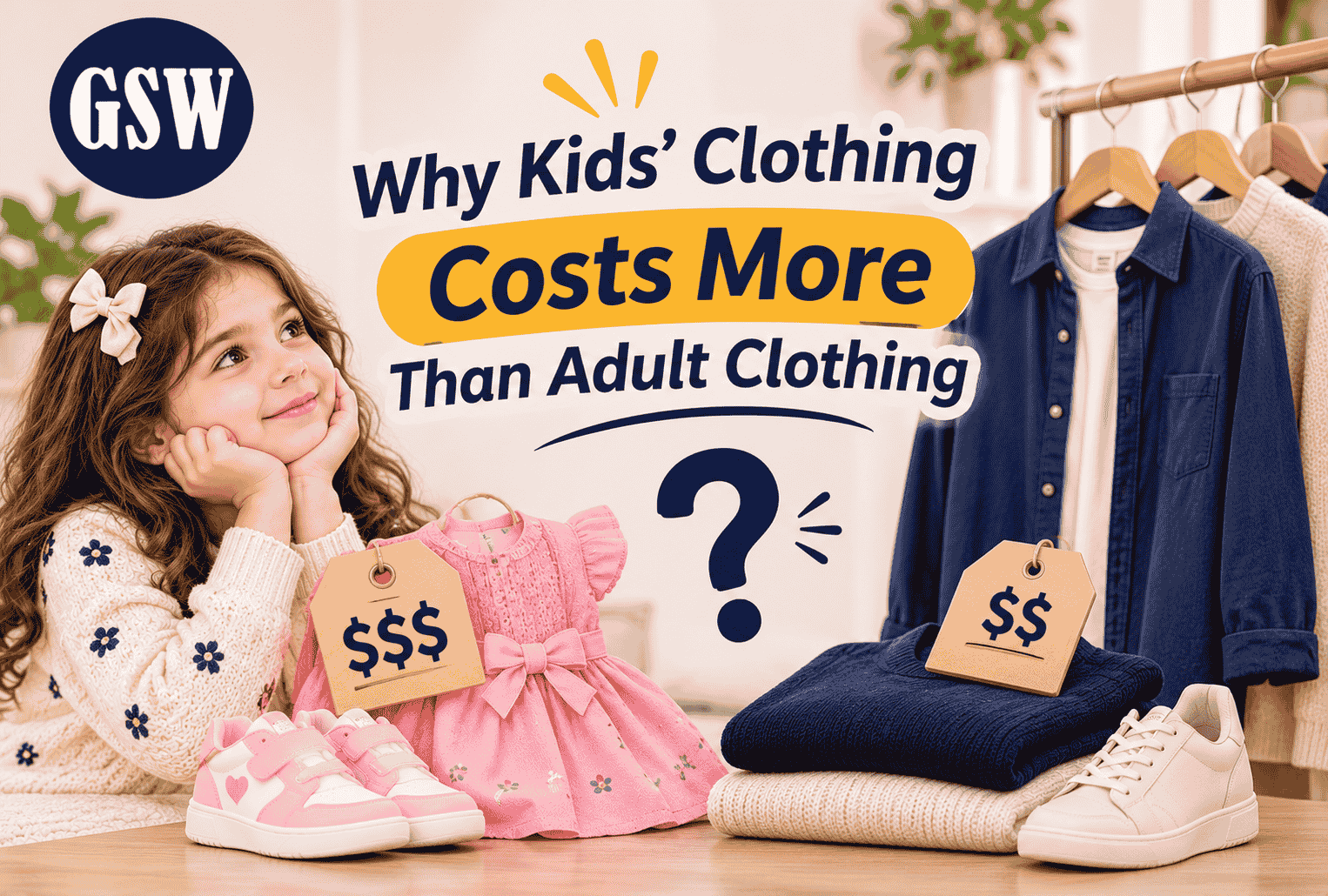
Have you ever wondered why kids’ clothing costs more than adult clothing, even when children’s outfits require less fabric? Many parents notice that a small children’s T-shirt, jacket or pair of shoes can cost almost as much as an adult version. In some cases, children’s clothing can even be more expensive.
The reason is that clothing prices are not determined by size alone. Fabric, design, manufacturing, safety requirements, order quantities, branding and retail expenses all influence the final price.
However, this does not mean every children’s garment costs more than its adult equivalent. Basic children’s clothes are often cheaper, while premium, highly decorated or specially designed items can have surprisingly high prices.
Understanding these factors can help parents make better shopping decisions, compare prices and choose clothing that offers good value for money.
Why Kids’ Clothing Costs More Than Adult Clothing: The Main Reasons
The cost of children’s clothing involves more than the amount of material used. Manufacturers and retailers consider several expenses before deciding how much a garment should cost.
Here are the main reasons why some children’s clothes can cost as much as adult clothing.
1. Less Fabric Does Not Always Mean a Lower Price
One of the most common assumptions is that smaller clothes should automatically be cheaper because they use less fabric.
Although children’s garments generally require less material, fabric is only one part of the total production cost.
A manufacturer still needs to cut, stitch, finish, inspect, package and transport each garment. Many of these processes involve similar costs regardless of whether the clothing is designed for a child or an adult.
For example, making a children’s cotton T-shirt still requires fabric preparation, stitching, neck finishing, labelling and quality checks.
The smaller size may reduce material expenses, but it does not eliminate the other costs.
An apparel industry explanation from ShirtSpace about youth versus adult clothing prices discusses how manufacturing and distribution costs can limit the savings from using less fabric.
2. Children’s Clothing Often Requires More Detailed Designs
Some children’s clothing looks simple, but certain designs involve additional work.
Decorative stitching, embroidery, appliqué, colourful prints, special buttons, zippers and other details can increase production costs.
Baby clothing can also require practical design features such as:
- Easy-to-open necklines.
- Convenient front fastenings.
- Soft seams.
- Comfortable elastic waistbands.
- Easy-access fasteners.
- Durable prints and finishes.
These details make garments more practical, but they may require additional materials, labour or manufacturing steps.
According to the Centre for the Promotion of Imports from Developing Countries (CBI), children’s clothing can involve more complicated designs even though average fabric consumption is lower than for adult clothing.
Read its market research on children’s wear manufacturing and pricing.
3. Smaller Production Orders Can Increase Manufacturing Costs
Manufacturing costs are affected by how many products a company produces in one order.
Adult clothing often benefits from larger, more predictable production runs in popular sizes. Children’s clothing may involve more size variations and different quantities for each age group.
For example, a manufacturer might need separate production quantities for newborns, toddlers, preschool children and older kids.
If a particular design sells in smaller quantities, the factory may find it harder to operate as efficiently as it would with a large production run.
The costs of setting up machines, preparing designs, arranging production and inspecting finished garments still need to be covered.
CBI’s children’s wear industry research identifies smaller order quantities and more complicated designs as challenges that can affect production efficiency.
This helps explain why a smaller garment does not necessarily receive a proportionally lower retail price.
4. Children’s Clothing Has Additional Safety Considerations
Safety is another important part of producing children’s clothing.
Garments intended for young children must be designed with their age, behaviour and everyday activities in mind.
For example, manufacturers and retailers may need to consider:
- Securely attached buttons and decorative parts.
- Safe placement of cords and drawstrings.
- Suitable materials and chemical restrictions.
- Durable stitching and garment construction.
- Appropriate labels and product information.
The exact legal requirements depend on the country where a garment is manufactured or sold.
For example, clothing sold in the European Union must meet applicable product-safety and chemical requirements. The EN 14682 standard addresses the safety of cords and drawstrings in children’s clothing.
These requirements can create additional design, testing and compliance work for manufacturers.
The National Retail Association’s children’s apparel product safety guidelines also explain the importance of evaluating clothing features such as buttons, decorative trims, cords and small components.
Safety is not an optional extra when designing clothing for children. It is part of responsible product development.
5. Premium Fabrics and Comfort Features Can Increase Prices
Parents often look beyond appearance when purchasing clothing for their children.
Comfort, softness, breathability and durability are important considerations, particularly for babies and young children.
Some premium children’s garments use:
- Organic cotton.
- Soft cotton blends.
- Merino wool.
- Durable knitted fabrics.
- Breathable materials.
- Wash-resistant prints and finishes.
These materials may cost more than basic fabrics.
Some brands also invest in reinforced seams, softer finishes and better shape retention to help garments withstand frequent washing.
However, not every expensive children’s outfit uses premium materials. Always check the fabric composition and product information rather than assuming that a higher price automatically means better quality.
6. Branding and Popular Characters Influence Children’s Clothing Prices
Children’s clothing frequently features popular cartoon characters, entertainment franchises, sports teams and well-known brands.
Parents may notice that a basic printed T-shirt costs less than a similar shirt featuring a licensed character.
This difference can reflect additional licensing arrangements, design fees, brand recognition and retail positioning.
Fashion labels may also charge higher prices for their children’s collections because of their established reputation and marketing strategy.
A branded outfit is not necessarily more durable or comfortable than an unbranded alternative.
Parents should compare the actual fabric, stitching, fit and care instructions before deciding whether a branded item is worth the extra expense.
7. Retail and Distribution Expenses Affect Final Prices
The price on a clothing label includes more than the factory cost.
Retailers must also account for expenses such as:
- Transportation and shipping.
- Warehousing and storage.
- Import duties and applicable taxes.
- Store rent and operating expenses.
- Marketing and advertising.
- Packaging and stock management.
- Returns and unsold inventory.
These expenses apply to children’s and adult clothing alike.
CBI’s European children’s wear market research explains how retailer markups account for transportation, import duties, marketing, overheads and other business expenses.
Consequently, even when a children’s garment costs less to manufacture, its final selling price may not be proportionally lower.
Prices also vary according to the country, store, retailer and market segment.
8. Children Outgrow Clothes Faster Than Adults
A major difference between children’s and adult clothing is how long garments generally remain useful.
Children grow, and their clothing sizes need to change accordingly.
A perfectly good jacket may become too small after a growth spurt. Shoes may need replacing even when their soles and upper materials are still in good condition.
This creates a recurring expense for parents.
For example, a parent may purchase several pairs of school trousers or everyday shoes within a relatively short period because the child has grown.
Adults usually do not experience the same size-related replacement cycle.
This means the total amount families spend on children’s clothing over a year can be significant, even when individual items are cheaper than adult equivalents.
9. Seasonal Clothing and School Requirements Add to the Budget
Children often need clothing for different activities and weather conditions.
Depending on the family and school, a clothing budget may include:
- School uniforms.
- Sportswear.
- Everyday casual outfits.
- Winter jackets.
- Summer clothing.
- Raincoats.
- Special-occasion outfits.
- Replacement shoes.
School uniforms can be particularly important because some schools require specific colours, designs or approved suppliers.
When children grow, parents may need to replace several uniform items at once.
Planning seasonal purchases and prioritising essential clothing can help families avoid unnecessary spending.
Are Kids’ Clothes Always More Expensive Than Adult Clothes?
No. Children’s clothing is not always more expensive than adult clothing.
In many cases, a basic children’s garment costs less because it uses less fabric and may have a simpler design.
For example, a basic children’s T-shirt may be cheaper than an adult T-shirt from the same retailer.
However, a premium children’s outfit with embroidery, licensed graphics, special fabrics or additional safety-related construction may cost as much as or more than a basic adult garment.
The fairest way to compare prices is to look at products with similar quality, materials, design, brand positioning and retail conditions.
Parents should also distinguish between two different costs:
Price per item: How much one garment costs.
Total yearly spending: How much a family spends replacing clothing as children grow or wear out their clothes.
This distinction explains why children’s clothing can create a substantial household expense even when many individual items are relatively affordable.
How Parents Can Save Money on Children’s Clothing
Understanding why kids’ clothing costs more than adult clothing is useful, but parents can also take practical steps to manage their shopping budgets.
1. Buy Essential Clothing First
Prioritise everyday outfits, school uniforms, appropriate shoes and seasonal essentials before buying optional fashion items.
2. Choose Versatile Clothing
Neutral colours and simple designs can be combined in different ways.
This reduces the need to purchase separate outfits for every occasion.
3. Compare Prices Between Retailers
Check similar products from different stores and compare fabric composition, construction, sizing and return policies.
Do not choose solely by the lowest price.
4. Shop During Seasonal Sales
End-of-season sales can provide opportunities to purchase suitable clothing at reduced prices.
However, avoid buying too far ahead if the child may outgrow the item before wearing it.
5. Consider Second-Hand Clothing
Gently used children’s clothing can offer excellent value because some garments are outgrown before they become heavily worn.
Clothing swaps between family members and friends can also reduce expenses.
6. Look After Existing Clothes
Follow washing instructions, repair small tears and store seasonal clothing properly.
Good clothing care can extend the useful life of garments.
7. Check Quality Before Buying
Examine stitching, zippers, buttons and fabric quality.
A slightly more expensive garment may offer better value if it lasts significantly longer.
Final Thoughts: Understanding the Real Cost of Children’s Clothing
The main reason some children’s clothing costs more than adult clothing is that retail prices depend on more than garment size.
Design complexity, production quantities, safety considerations, fabric quality, branding and distribution expenses can all influence the final price.
Children also outgrow clothing faster, creating additional replacement costs for families.
However, there is no universal rule that children’s clothes are always more expensive. Basic garments can be cheaper, while premium or specialised designs may cost more.
For parents, the best approach is to compare similar products, prioritise quality and purchase clothing according to a realistic family budget.
A good children’s wardrobe should balance comfort, durability, safety and personal style without unnecessary spending.
Explore more practical outfit ideas and children’s clothing inspiration in the Kids Fashion collection at GupShup World.
Frequently Asked Questions
1. Why do children’s clothes sometimes cost as much as adult clothes?
Children’s garments use less fabric, but production still involves cutting, stitching, finishing, quality checks, packaging and transportation. More complicated designs, smaller production orders and retail expenses can reduce the price advantage of smaller sizes.
2. Are children’s clothes more expensive to manufacture?
Not always. Manufacturing costs depend on fabric, labour, order quantities, design complexity and quality requirements. Some children’s garments may cost less to produce, while specialised or detailed designs can involve additional expenses.
3. Why are baby clothes sometimes expensive?
Baby clothes may use specialised materials, soft seams, practical fastenings and durable finishes. Certain markets also have specific product-safety and chemical requirements. Premium fabrics and smaller production quantities can further influence prices.
4. Why do parents spend so much on children’s clothing?
Children grow quickly and regularly need replacement clothing and footwear. School uniforms, seasonal outfits, sportswear and everyday essentials can also add to annual household spending.
5. How can parents buy affordable children’s clothes without compromising quality?
Compare similar garments, check fabric and stitching quality, shop seasonal sales, consider good-condition second-hand clothing and prioritise versatile designs. Choosing durable clothing can provide better value over time.