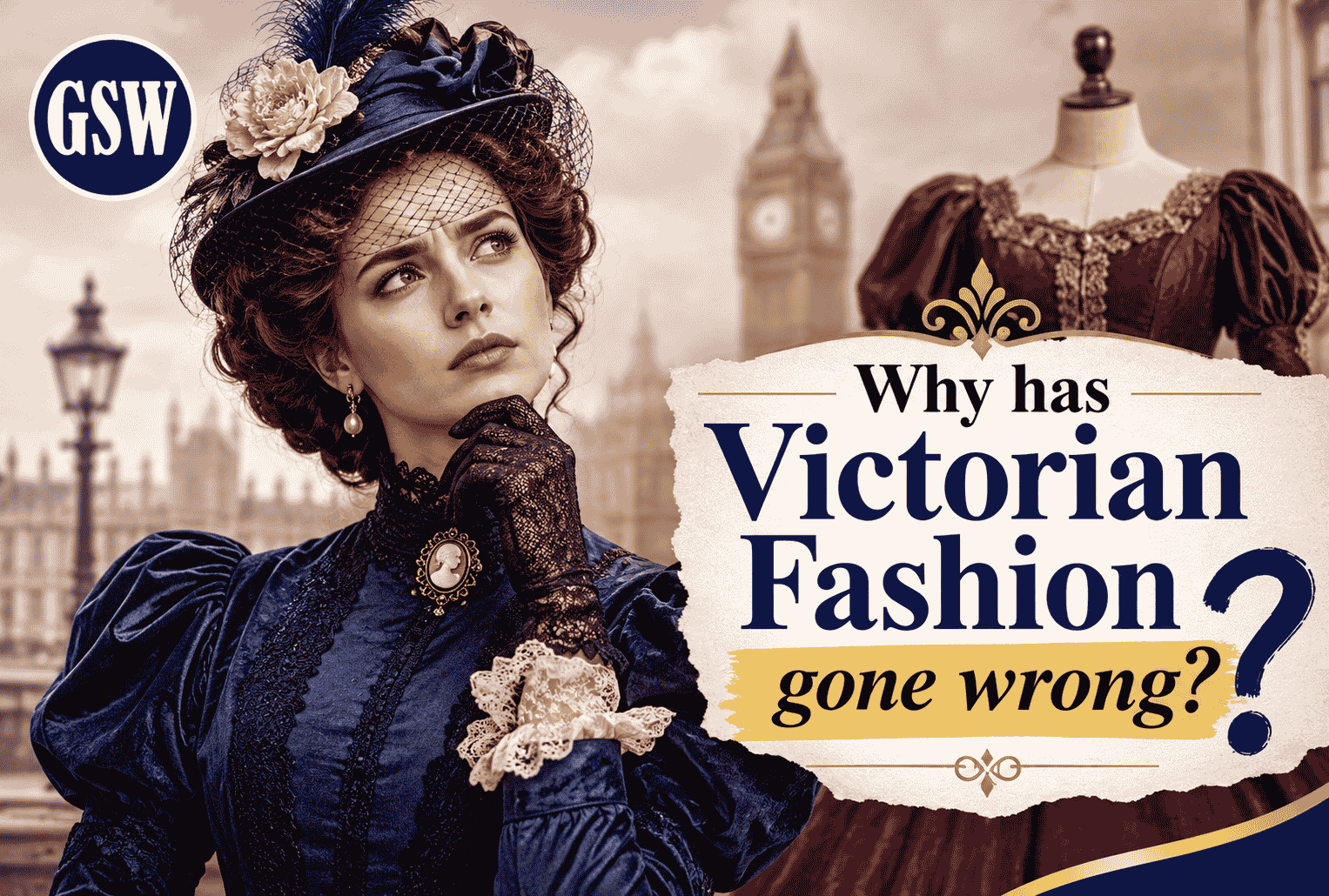
Victorian fashion is famous for its elegant dresses, dramatic silhouettes, detailed embroidery, corsets and elaborate accessories. Yet, behind its beautiful appearance, some aspects of the period’s clothing raise questions about comfort, practicality and historical expectations. So, why has Victorian fashion gone wrong?
The answer is more complicated than saying that Victorian clothing was simply uncomfortable or outdated. The original fashion of the Victorian era was diverse and constantly changing. What often goes wrong is the way modern interpretations simplify its history, romanticise restrictive clothing or combine historical details without understanding their original purpose.
From tightly structured corsets and oversized bustles to modern Gothic-inspired outfits, Victorian fashion has both an impressive history and complicated elements worth examining.
Understanding these differences helps us appreciate the original designs while recognising why some modern adaptations do not always work.
Why Has Victorian Fashion Gone Wrong? Understanding the Real Issue
Victorian fashion has not necessarily gone wrong as a historical style. The problem often comes from modern interpretations that focus heavily on dramatic appearances while ignoring historical accuracy, everyday comfort and the original purpose of garments.
Many modern recreations emphasise extreme corsets, oversized skirts and decorative details without considering how Victorian clothing actually changed between 1837 and 1901.
The Victorian era lasted more than six decades, and women’s clothing evolved significantly during that period.
The Victoria and Albert Museum explains how corsets, crinolines, bustles and changing attitudes towards women’s dress influenced different Victorian silhouettes.
This historical context is important because there was never just one single Victorian fashion style.
1. Corsets Became More About Shape Than Everyday Comfort
Corsets are among the most recognisable elements of Victorian fashion.
They were used to shape the torso and create the waistline associated with fashionable dresses. Their construction included materials such as cotton, metal busks, cording and baleen boning.
Different designs supported different silhouettes, depending on the decade and prevailing fashion preferences.
Why Did Corsets Become Controversial?
Corsets could apply pressure around the torso, particularly when tightly laced.
During the Victorian era, the fashionable hourglass silhouette became increasingly prominent, leading to debate about body shaping and physical freedom.
Some women preferred wearing corsets and considered them an important part of their clothing. Others supported dress reform and wanted more practical garments that allowed greater movement.
The V&A documents this debate and explains how different corset designs evolved towards more flexible alternatives during the later Victorian period.
The issue is therefore not that every historical corset was identical or harmful. Rather, the increasing emphasis on shaping the body created genuine disagreements about comfort and freedom.
For modern fashion, the lesson is simple: a garment should complement the wearer without requiring unnecessary physical discomfort.
2. Oversized Bustles Made Movement More Difficult
Bustles became an important feature of women’s fashion during the 1870s and 1880s.
They were designed to create volume at the back of the skirt, producing the distinctive silhouette associated with late Victorian dresses.
Different materials were used to construct them, including steel structures, horsehair and padded fabrics.
Although bustles created dramatic visual effects, some designs could make everyday activities more difficult.
Their size and construction could affect how women walked, sat and moved.
The V&A notes that some bustle structures became particularly restrictive, with wearers sometimes having to adjust their position when sitting.
Why Are Extreme Bustle Designs Problematic Today?
Modern interpretations sometimes exaggerate the shape even further, placing visual drama above practical wearability.
This can make an outfit look more like a theatrical costume than contemporary clothing.
For an everyday interpretation, softer volume, carefully placed pleats or a structured back detail can provide Victorian inspiration without recreating an excessively restrictive silhouette.
3. Victorian Fashion Was Not the Same Throughout the Era
One of the biggest mistakes in modern Victorian-inspired styling is treating the entire 1837–1901 period as one fashion movement.
Clothing changed considerably between the early, middle and late Victorian decades.
Early Victorian Fashion: 1837–1849
Early Victorian dresses often featured wide skirts, fitted bodices, shaped waistlines and distinctive sleeve designs.
Corsets and multiple petticoats helped create the desired silhouette.
Mid-Victorian Fashion: 1850s–1860s
During the middle of the century, cage crinolines became popular.
These structures supported large skirts and reduced the need for numerous heavy petticoats.
The Metropolitan Museum of Art explains how cage crinolines transformed skirt proportions during the mid-19th century.
Late Victorian Fashion: 1870s–1880s
The bustle became a major feature, shifting much of the skirt’s volume towards the back.
Fashionable dresses frequently included elaborate pleats, layers and decorative details.
1890–1901
Towards the end of the Victorian period, silhouettes changed again.
Bustles became less dominant, skirts became simpler and attention shifted towards larger sleeves and different body proportions.
The growing interest in practical clothing and the New Woman movement also influenced dress reform.
For a detailed historical explanation, read the V&A’s guide to Victorian corsets, crinolines and bustles.
4. Modern Victorian Fashion Often Focuses Too Much on Appearance
Victorian-inspired fashion can be beautiful, but reproducing its most dramatic visual elements without understanding their original context can create problems.
For example, some modern outfits combine extremely tight corsets, oversized skirts, lace collars and decorative accessories simply because they look historically themed.
The problem is not experimentation. Fashion has always evolved through creative interpretation.
The issue arises when a modern outfit is presented as historically accurate despite combining elements from completely different decades or ignoring the materials and construction techniques originally used.
How to Avoid This Mistake
Before creating a Victorian-inspired outfit:
- Choose a particular decade as your reference.
- Understand the original silhouette.
- Consider the fabric and garment construction.
- Avoid combining too many dramatic elements.
- Adapt the outfit for modern comfort.
A historically inspired outfit can still look modern without pretending to be an exact reproduction.
5. Class Differences and Social Expectations Are Often Ignored
Victorian fashion was also influenced by class, income and social expectations.
Clothing was an important way of communicating social position and respectability.
Wealthier women could afford elaborate fabrics, customised garments, decorative details and assistance with dressing.
Working-class women generally had different clothing budgets and practical requirements.
However, industrialisation gradually made more fashionable garments accessible through ready-made clothing, department stores, fashion publications and mail-order catalogues.
HISTORY’s research, including comments from Valerie Steele of the Museum at FIT, explains how industrial developments changed clothing production and made fashion available across a wider range of society.
Why This Matters for Modern Fashion
Modern recreations frequently focus on wealthy Victorian wardrobes because elaborate dresses create visually impressive photographs.
This can give an incomplete picture of the period.
Victorian clothing was not limited to ballroom gowns and elaborate corsets. Everyday garments, practical clothing and garments made for different social classes were also part of the era’s fashion history.
Understanding this distinction creates a more accurate appreciation of Victorian clothing.
6. Modern Victorian Revival Can Become Overly Theatrical
Victorian-inspired clothing has continued to influence contemporary designers and fashion enthusiasts.
In October 2026, ELLE reported on a renewed dark-romantic Victorian influence in fashion, including high collars, bustles, corsetry, statement jewellery and gothic-inspired details.
The report discussed how film and television, alongside contemporary runway collections, have helped bring this aesthetic into the current fashion conversation.
However, runway fashion and everyday clothing serve different purposes.
A dramatic outfit designed for a fashion show or editorial photograph does not necessarily translate well into daily life.
Making Victorian Fashion More Wearable
You can incorporate selected historical details without wearing a complete period costume.
For example:
- Pair a lace blouse with modern tailored trousers.
- Wear a high-neck top with a contemporary skirt.
- Add a statement brooch to a simple dress.
- Choose subtle corset-inspired tailoring rather than restrictive lacing.
- Combine vintage jewellery with modern clothing.
These combinations preserve the visual character of Victorian fashion while remaining suitable for everyday activities.
7. Heavy Fabrics and Excessive Layers Are Not Always Practical
Victorian fashion often involved multiple layers, structured undergarments and substantial decorative details.
Depending on the garment, these could include petticoats, corset covers, outer skirts and other supporting components.
While such construction helped create the desired silhouette, it could also make dressing and movement more complicated.
Modern clothing offers different priorities.
Lightweight fabrics, breathable materials and practical construction can create a more comfortable interpretation of historical fashion.
This does not mean historical clothing should be judged only by modern expectations. It means contemporary designers should consider the needs of today’s wearers when adapting older designs.
8. Victorian Fashion Should Be Inspired by History, Not Blindly Copied
One of the most effective ways to appreciate Victorian fashion is to understand its original purpose and then select the details that suit your personal style.
Instead of reproducing every historical layer, focus on the elements that make the period visually distinctive.
Romantic Victorian Style
Soft lace, flowing sleeves, high necklines and delicate decorative details can create a romantic appearance.
Gothic Victorian Style
Darker colours, structured silhouettes, decorative jewellery and dramatic fabrics can produce a Gothic-inspired look.
Modern Victorian Minimalism
A high-neck blouse, structured jacket or antique-inspired brooch can introduce historical character without overwhelming the outfit.
Vintage-Inspired Eveningwear
Long dresses, elegant fabrics and carefully selected accessories can create a sophisticated interpretation suitable for special occasions.
These approaches allow modern fashion to respect historical inspiration while remaining practical.
9. Why Victorian Fashion Still Inspires Designers in 2026
Despite its complicated history, Victorian fashion continues to influence contemporary clothing.
Designers often revisit historical fashion because it offers distinctive silhouettes, construction techniques, decorative details and opportunities for creative reinterpretation.
The current dark-romantic revival is one example.
ELLE’s October 2026 report discusses Victorian references appearing in contemporary collections and fashion-related screen productions.
The attraction includes more than corsets and bustles. Details such as intricate craftsmanship, high collars, antique-inspired jewellery, lace and layered clothing also contribute to the aesthetic.
These influences show that historical fashion can remain relevant when designers adapt it thoughtfully.
Final Verdict: Why Has Victorian Fashion Gone Wrong?
Victorian fashion has not simply gone wrong. Its historical designs were part of a changing society, and its silhouettes evolved throughout the 19th century.
What can go wrong is the way these styles are interpreted today.
Ignoring historical differences, romanticising restrictive garments, exaggerating silhouettes and prioritising appearance over comfort can result in inaccurate or impractical recreations.
A better approach is to understand the original designs, appreciate their cultural and historical context, and adapt selected details for modern clothing.
Victorian fashion can still offer inspiration through elegant fabrics, intricate details, structured tailoring and expressive accessories.
The goal should not be to copy the past exactly. It should be to understand what made it distinctive and bring those ideas into contemporary style in a thoughtful way.
Explore more historical inspiration, outfit ideas and styling guides in the Womens Fashion collection at GupShup World.
Frequently Asked Questions About Victorian Fashion
1. Why has Victorian fashion gone wrong?
Victorian fashion has not necessarily gone wrong. Problems usually arise when modern interpretations exaggerate historical silhouettes, ignore the differences between Victorian decades or prioritise appearance over comfort and practicality.
2. Why were Victorian dresses so restrictive?
Many fashionable Victorian dresses used structured undergarments such as corsets, crinolines and bustles to create specific silhouettes. These garments could restrict movement, although their construction and level of restriction varied throughout the era.
3. Is Victorian fashion coming back in 2026?
Victorian-inspired fashion has received renewed attention in 2026, particularly through dark-romantic styling, lace, high collars, corsetry and antique-inspired accessories. Contemporary fashion coverage has also highlighted these historical references in recent runway and screen productions.
4. What are the main features of Victorian women’s fashion?
Important features included structured bodices, corsets, wide skirts, crinolines, bustles, decorative sleeves, lace and detailed accessories. Their popularity and construction changed significantly between 1837 and 1901.
5. How can women wear Victorian fashion in a modern way?
Women can incorporate Victorian inspiration through lace blouses, high-neck tops, structured jackets, flowing skirts, antique-style jewellery and corset-inspired designs. Combining these pieces with contemporary clothing creates a wearable modern interpretation.